Law Enforcement Expert Allowed to Opine on the Standards For Use of Lethal Force
Posted on October 30, 2026 by Shuva Guha Thakurta
In April 2022, Plaintiff filed suit against Sheriff Schuster and Mohave County Deputies Cardenas, Farney, Godfrey, and Shrader, raising a number of federal and state law claims arising out of the deadly shooting of Bradley Rose ("Decedent").
Defendants sought to exclude the expert testimony of Plaintiff's expert, Mr. Roger A. Clark, in its entirety.
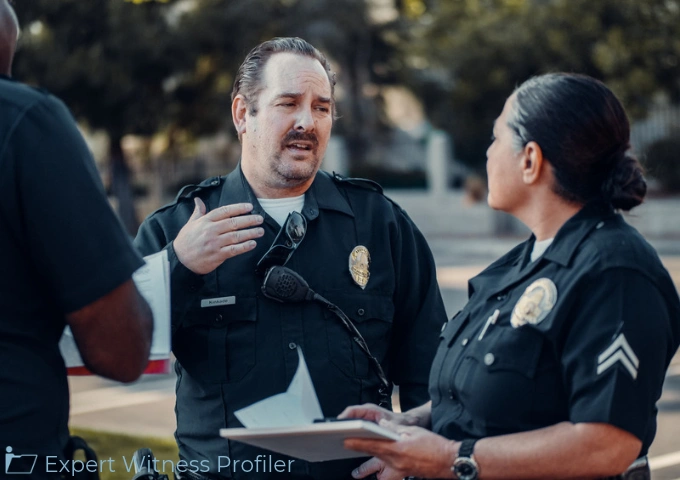
Law Enforcement Expert Witness
Roger Alma Clark is a retired law enforcement professional with 27 years of experience in the Los Angeles County Sheriff’s Department (LASD). He was hired on December 1, 1965, and served until his retirement on March 31, 1993. Throughout his distinguished career, he held several key positions, including six years as a Deputy Sheriff, six years as a Sergeant, and 15 years as a Lieutenant. Roger retired with a California Peace Officer Standards and Training (POST) Advanced Certificate and is a graduate of the POST Command College, class #5, 1988.
Discussion by the Court
1. Qualifications
Defendants argued that Clark is not qualified to give medical opinions on whether Decedent was experiencing a mental health crisis, whether Deputy Farney should have identified that Decedent was experiencing a mental health crisis, or whether the other officers should have provided medical care.
Plaintiff agreed to exclude testimony from Clark that diagnoses Decedent, establishes that Decedent was experiencing a mental health crisis, or prescribes appropriate medical treatment. And Plaintiff will not offer the report’s criticisms of other deputies’ post-shooting medical care. The Court therefore found this argument moot.
2. Reliability
a. Lack of Reliable Methodology
Defendants first argued that Clark’s opinions should be excluded in their entirety because his “opinions on the standards for use of lethal force lack any reliable methodology,” and therefore, “Clark cannot reliably opine that [Deputy] Farney failed to comply with any lethal force standard.”
Regarding Defendants’ argument that Clark’s opinions are entirely unreliable due to his failure to cite the sources for his opinions, the Court disagreed. Plaintiff correctly pointed out that Clark cited to the investigative interviews, surveillance recordings, body camera recordings, photographs, deposition transcripts, dispatch communications, training records, and departmental policies he reviewed. Therefore, the Court declined to find that Clark’s opinions are entirely unreliable on this basis.
The Court is equally unpersuaded by Defendants’ argument that the materials Clark reviewed do not comport with “generally accepted national standards.”
To the extent Plaintiff sought to admit Clark’s opinion that Deputy Farney approached Decedent with his firearm drawn and attempted physical control with only one available hand, the Court will determine whether this testimony is reliable. Plaintiff contended that Clark explains police procedures and their application to Deputy Farney’s approach.
Defendants concede that it would not be “inappropriate for Clark to opine on whether [Deputy] Farney’s use of force complied with policies or procedures,” provided Clark had “properly supported or disclosed [those] opinions.” As analyzed above, Clark has properly supported his opinions by citing the investigative interviews, surveillance recordings, body camera recordings, photographs, deposition transcripts, dispatch communications, training records, and departmental policies he reviewed. The Court found no reason to exclude this portion of Clark’s opinion at this time.
b. Failure to Consider Additional Facts
Defendants next argued that Clark failed to consider certain portions of Deputy Farney’s testimony, and therefore Clark’s testimony is “fundamentally unreliable.” Specifically, Clark failed to consider that Decedent twice grabbed Deputy Farney’s firearm and punched him in the head. And Clark impermissibly opined that Deputy Farney “could not have reasonably believed that any of the above circumstances existed at the time he used deadly force on [Decedent].”
Plaintiff concedes that he will not offer the portion of Clark’s testimony relating to the conclusion that “Deputy Farney could not reasonably have believed deadly force was necessary because [Decedent] possessed no firearm and made no verbal threat.” And Plaintiff correctly pointed out that Clark’s report addresses Deputy Farney’s version of the events. Indeed, Clark’s report notes that according to Deputy Farney, Decedent struck him in the temple.
Further, unless an expert’s opinion lacks enough accurate factual information to provide a reasonable factual foundation, “criticism of an expert’s decision to base an opinion on some facts but not others should be challenged through the traditional means at trial, not through a Daubert motion.”
Accordingly, the portion of Defendants’ motion to preclude regarding whether Clark may offer legal conclusions on whether Defendant Farney could have reasonably believed deadly force was necessary is moot because Plaintiff concedes he is not offering that opinion; as to all other aspects of Defendants’ argument that Clark’s opinions are unreliable because he failed to consider additional facts, the motion to preclude is denied without prejudice to Defendants cross-examining Clark during trial regarding what facts he considered and raising any objections that may arise during the course of trial.
c. Lack of Sufficient Facts and Data
Defendants next argued that Clark “fails to provide sufficient facts to establish that Deputy Farney violated any standard or policy.”
Plaintiff correctly argued that Clark’s report indicates which specific policies and procedures Clark referenced in forming his opinion: “AZ Post Behavioral Health Crisis Response 3.4, Excited-agitated Delirium Poster, PP Training Young v. Kileen, Handout re Tactics and Police Procedures Young v. Kileen, MSCO Policy 300 Use of Force, MSCO Policy 307 Vehicle Pursuits, and MSCO Policy 420 Body Worn Camera.” This information sufficiently apprises Defendants of the materials Clark reviewed in forming his opinions. Defendants will have the opportunity to cross-examine Clark to challenge the weight of his opinions. Accordingly, the Court found that Clark’s opinions are based on sufficient factual foundation.
3. Relevance
Defendants argued that Clark’s remaining opinions regarding the dismissed claims are irrelevant. However, Plaintiff stipulated to omitting the portions of Clark’s testimony regarding the dismissed claims. Accordingly, this argument is moot, and Clark may not offer his opinion on the evidence regarding the dismissed claims.
Defendants next argued that testimony regarding whether the Sheriff’s policies and customs were adequate and whether Deputy Farney was sufficiently trained is irrelevant to whether Deputy Farney used excessive force with Decedent. Plaintiff, however, has also agreed to not offer portions of Clark’s opinion relating to “inadequate training or supervision.” And Plaintiff acknowledged that whether Deputy Farney violated the Fourth Amendment is an issue for the jury to determine. This portion of Defendants’ argument is therefore moot, and Clark may not testify regarding inadequate training or supervision or offer an opinion on whether Deputy Farney violated the Fourth Amendment.
4. Substitution of Expert Opinion for that of the Jury
Defendants argued that Clark improperly opined on the ultimate issue of Deputy Farney’s liability. But Plaintiff agreed to refrain from offering characterizations of Deputy Farney’s tactics as “negligent” or that his conduct was “excessive or unreasonable, violated the law as taught by AZPOST, or reflected deliberate indifference.” And Plaintiff concedes that he will not seek to admit Clark’s statements regarding “reverence for life,” deadly force as a last resort, and “subjective fear.” Plaintiff will also not suggest that Deputy Farney was required to exhaust every alternative before using deadly force, offer “reverence for life” as a separate legal requirement, or ask Clark to opine on Deputy Farney’s personal regard for Decedent’s life. Once the opinions that Plaintiff concedes he will not inquire about are removed, the Court found that Clark’s testimony is not on the ultimate issue; and it will not be precluded as such.
Defendants contended that Clark improperly “implies that an officer may use deadly force only if he has exhausted all non-lethal options.” Plaintiff expressly states that he “will not offer the report’s ‘last resort’ formulation to suggest that Deputy Farney was legally required to exhaust every alternative before using deadly force.” Moreover, Defendants argued that Clark’s opinions regarding “subjective fear” are not relevant to whether Deputy Farney’s use of force was reasonable. Plaintiff agreed that “Clark will not diagnose . . . Deputy Farney’s mental state,” and that Clark’s statements regarding “subjective fear” will not be offered “as instructions on the governing law.” Accordingly, this argument is also moot, and Clark may not offer expert opinion to diagnose Deputy Farney’s mental state.
Held
The Court denied the Defendants' motion to exclude the opinions of expert Roger Clark, and Roger Clark may offer his opinions from his report except that he may not offer any opinions that Plaintiff stipulated will not be elicited at trial as specified above.
Key Takeaway
The test of reliability is flexible and requires the district court to “assess the expert’s reasoning or methodology, using as appropriate criteria such as testability, publication in peer-reviewed literature, known or potential error rate, and general acceptance.” These factors are nonexclusive, and “the trial court has discretion to decide how to test an expert’s reliability . . . based on the particular circumstances of the particular case.” Accordingly, the Court finds it inappropriate to exclude Clark’s opinions in their entirety based on the reasoning that Clark failed to cite materials that comport with generally accepted national standards.
Case Details:
Case Caption: | Rose V. Farney |
|---|---|
Docket Number: | 3:22cv8055 |
Court Name: | United States District Court for the District of Arizona |
Order Date: | October 29, 2026 |