Emergency Medicine Expert Allowed to Opine on Foot Injuries
Posted on August 6, 2026 by Shuva Guha Thakurta
On April 17, 2026, Plaintiff George Gonzalez alleged violations of the Fourth Amendment to the U.S. Constitution and related state-law claims arising from the January 24, 2024 law enforcement shooting of Plaintiff.
Plaintiff sought to exclude the testimony from Defendants' animation and reconstruction expert, Samir Lyons, and bullet trajectory expert Rod Englert. Defendants Sean Irick and the State of California filed motions seeking to exclude the testimony of Plaintiff's "videographer, editor, and forensic video analyst" Scott Holdaway and medical expert Dr. Ryan S. O'Connor.
Animation Expert Witness
Samir Lyons has more than 18 years of professional experience as a 3D artist and animator. Lyons' career has spanned multiple industries, including forensic visualization, feature films, television, online advertising, and video games.
Law Enforcement Expert Witness
Rod Englert is a 53-year veteran of law enforcement. He has consulted in over 500 criminal and civil death cases in the United States. He has testified and is a qualified court expert in homicide in 26 states.
Digital Media Expert Witness
Scott Holdaway is a Forensic Video Analyst with over six years of experience and expertise in video clarification, timing, graphics, stabilization, and conversions. Holdaway graduated magna cum laude from California State University, Dominguez Hills with a BA in Digital Media Arts.
Emergency Medicine Expert Witness
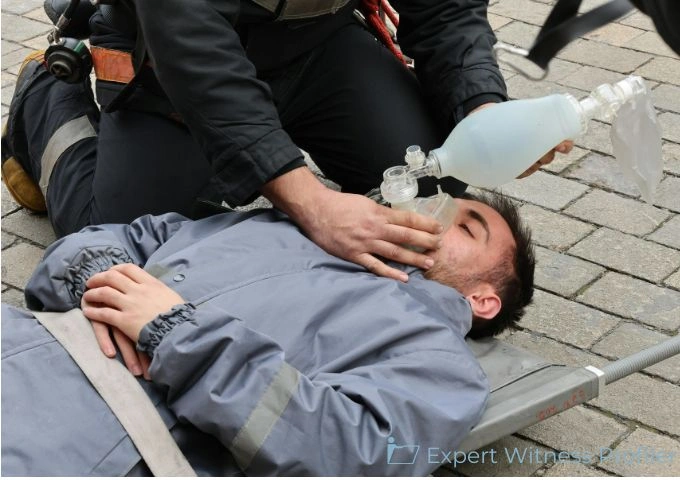
Dr. Ryan Scarritt O'Connor has worked for over 20 years as an attending emergency room physician throughout the country. In addition, O'Connor has conducted 200 hours of fieldwork at the Los Angeles County Department of Medical Examiner, completed coursework on forensic pathology, firearms, and crime scene reconstruction, and has advised pathologists and medical practitioners.
Discussion by the Court
a. Samir Lyons
The Court found Lyons' testimony excludable due to Defendants' complete failure to comply with this Court's scheduling order and the Federal Rules. In relevant part, the Court's Civil Trial Scheduling Order provided a December 4, 2025 deadline for initial expert reports and a January 8, 2026 deadline for expert discovery. Federal Rule of Civil Procedure 26(a)(2)(B) sets forth the requirements for expert disclosure. Among other things, it requires disclosure of a written report that contains: a complete statement of all opinions the witness will express and the basis and reasons for them and the facts and data considered by the witness in forming them. Here, Lyons' one-and-a-half-page report falls far short of what is required. His two sentence "summary" of opinions merely states he was retained "to collaborate with Englert Forensics to create demonstratives of their opinions and analysis" and "I reserve the right to produce demonstrative animations or visuals based on Englert Forensics' analysis." Notably, Defendants did not appear to argue Lyons' report complies with the relevant rules. Hence, Lyons' testimony shall be excluded.
b. Rod Englert
The Court found that Englert's testimony is both relevant and reliable. First, Englert's testimony is relevant to the extent it is based on his forensic analysis of the evidence in this case. Defendants plan for Englert to testify about his review of physical evidence, medical reports, law enforcement records, and other evidence to "educate the jury how the bullets traveled and impacted Plaintiff on the night of the incident."
This testimony is relevant to understanding the incident and injuries to Plaintiff. Englert's proffered testimony regarding his forensic analysis of materials including investigative documents, physical evidence, video and audio evidence, photographs, and his visit to the scene of the incident is relevant to assist the jury in understanding the videos of the body camera footage evidence in the case.
Further, in light of the supplemental disclosure, and Englert's reconstruction report dated January 8, 2026, Englert may testify to the "forensic incident analysis opinions" he formed with "a reasonable degree of scientific probability" based on a review of case evidence. His report and derivative testimony are the product of reliable methods, reflecting a reliable application of the principles and methods of forensic analysis.
Second, Englert is qualified to testify in the areas proffered. He received a Bachelor’s degree in Police Administration from California State University at Los Angeles and has done post-graduate work in psychology. Englert is a graduate of the FBI National Academy, where he was President of the 159th Session.
c. Scott Holdaway
Holdaway intended to testify about his video analysis services and production of video reconstructions of the January 24, 2024 incident. Defendants contended that "the jury is fully capable of watching and interpreting the contents of the videos and audio of the incident and then using their own interpretation to assist them in making the necessary factual determinations."
The Court found that Holdaway's testimony and video reconstructions are admissible. First, Holdaway's testimony will help the jury understand the body camera footage in this case. His observations in the synchronized videos are relevant to presenting body camera footage of the incident in a logical manner for the jury. Additionally, Holdaway's testimony has a "valid connection to the pertinent inquiry," insofar as Plaintiff's claims stem from Defendant Irick's alleged firing of approximately five shots at Plaintiff from behind.
Further, Holdaway's testimony is "based on sufficient facts or data" and the videos are "the product of reliable principles and methods." Holdaway's opinion on the contents of the body camera footage has a reliable basis in the field of video analysis. According to his expert report and deposition testimony, Holdaway enlarged, stabilized, and annotated video as part of a frame-by-frame analysis of the body-worn camera footage worn by law enforcement on the night of the incident.
Hence, the video reconstructions were made in a manner consistent with his knowledge and experience. To the extent Defendants raised issues regarding Holdaway's credibility, such concerns go to the weight of the evidence, and Defendants may cross-examine him accordingly.
d. Dr. Ryan O'Connor
The Court found that O'Connor's testimony is admissible as both relevant and reliable. First, O'Connor's testimony is relevant to assess the extent of Plaintiff's injuries caused by Defendant Irick's use of force. Second, O'Connor's testimony is sufficiently reliable and he is qualified to testify to the contents of his report.
O'Connor reviewed over 1,700 pages of Plaintiff's medical record and other materials relevant to this case, including emergency room medical records that he "routinely reviews" as an attending emergency room physician.
Defendants argued that O'Connor's testimony on injuries to Plaintiff's foot and colon should be limited because he is not an orthopedic surgeon or proctologist. Though O'Connor is not an orthopedic surgeon or proctologist, the Court found his years of training, experience, and coursework involving rotations in orthopedics, surgical critical care, and internal medicine sufficient to permit him to opine on these issues. Defendants' concerns go to weight not admissibility. Further, O'Connor is qualified to testify about Plaintiff's bullet wounds and the path of the bullets in his bodies. This testimony is based on his assessment of Plaintiff's gunshot wounds, education on forensic pathology, training, and experience.
Held
The Court granted Plaintiff's motion in limine to exclude the testimony of Samir Lyons.
The Court denied Plaintiff's motion in limine to exclude the testimony of Rod Englert.
The Court denied Defendants' motion in limine to exclude the testimony of Scott Holdaway.
The Court denied Defendants' motion in limine to exclude the testimony of Ryan O'Connor.
Key Takeaway
Rule 702 allows the admission of relevant and admissible expert testimony. There are many situations in which an expert can recount what she observed in video or photographic evidence in order to explain the basis for her opinion, provided she is, of course, qualified to render an opinion on the subject.
Case Details:
Case Caption: | George Gonzalez V. State of California |
|---|---|
Docket Number: | 5:25cv331 |
Court Name: | United States District Court, California Central |
Order Date: | April 22, 2026 |