Civil Engineering Expert Not Allowed to Opine on Nose Moldings
Posted on August 19, 2026 by Shuva Guha Thakurta
The action arises from Latika Kaku's trip and fall on the stairs while exiting the IMAX auditorium at the Regal Downington movie theater in December 2022.
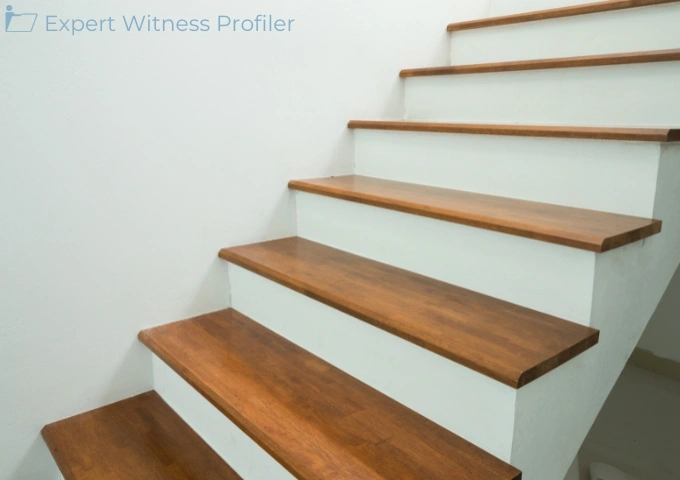
Plaintiffs relied on their expert, David J. Littlewood, to assert that the stairway at the Regal Downington presented a trip and fall hazard in 2022 due to cracks and separations in the rubber nose molding on the edge of the individual steps, and that this hazard caused Kaku's fall and injuries. Defendants sought to exclude the opinions of Plaintiffs' expert Littlewood.
Civil Engineering Expert Witness
David James Littlewood has a Bachelor of Science and Master of Science in Civil Engineering from Villanova University, and is licensed as a professional engineer in Pennsylvania, Delaware, and New Jersey. His expertise includes premises liability, walkway surfaces, and code and safety compliance regarding walkways and stairways.
Discussion by the Court
In his expert report, Littlewood opined that the cracks and separations in the nose moldings created a vertical change in elevation that was not reasonably expected and difficult to observe; Defendants knew or should have known that this defect in the nose molding presented a fall hazard for customers; Defendants should have but failed to provide reasonable inspections that would have identified the hazard; Defendants failed to repair the nose molding and eliminate the fall hazard; and Defendants' failure to inspect and maintain the stairs in compliance with applicable codes caused Kaku's fall.
A. Motion for Leave to File Surreply
The Court first addresses Plaintiffs' motion for leave to file surreply regarding the motion to exclude. Plaintiffs filed a motion for leave to file surreply, which Defendants oppose. Attached to the surreply is an affidavit dated March 16, 2026, from Littlewood explaining that in addition to the photos he personally took during his site inspections in 2025, he also considered a photo of the stairs taken by Dailey in December 2022 (produced by Defendants during discovery) and a photo taken in August 2023 (produced by Plaintiffs during discovery). Littlewood asserted that these photos show the same cracks in the nose molding that he observed during his own inspection of the stairs in 2025. Defendants contended that granting the motion for leave to file surreply will allow Plaintiffs to address arguments that Defendants raised in their original Motion to Exclude (rather than any new issues raised in Defendants' Reply) and present new opinions from Littlewood. Though not explicitly stated, Defendants suggested that the Court should exclude Littlewood's "new 'methodology'" as presented in the surreply for failure to comply with Rule 26.
In their reply in support of the motion for leave to file surreply, Plaintiffs characterize the information in Littlewood's affidavit as "only noting an additional piece of evidence that supports the same opinion he gave in his expert report," but also refer to that same information as an "additional opinion" and a "late opinion." Putting aside these inconsistencies in Plaintiffs' language, in reviewing the affidavit the Court finds that Littlewood's ultimate opinions—that the defects in the nose molding existed in 2022 and caused Kaku's fall at that time—remain unchanged. As such, Littlewood's affidavit does not present new opinions, but rather gives more information regarding the basis for the opinions he previously expressed.
The Court finds that the exclusion of the evidence contained in Littlewood's affidavit is not warranted under Rule 37. Here, the photos Littlewood references in the affidavit are not new or surprising to Defendants since they were produced during discovery, including by Defendants. Moreover, any prejudice to Defendants caused by allowing this evidence is minimal and easily cured. While Defendants may not have been able to ask Littlewood about his methodology in comparing these photos during his initial deposition, Plaintiffs have indicated that they would stipulate to Defendants filing a supplemental rebuttal report before trial. A trial date has not yet been set, so no existing court calendar would be affected by a rebuttal report. Additionally, Defendants point to no bad faith or willfulness on the part of Plaintiffs that caused the delayed disclosure of this information. Finally, the evidence is important to the Court's determination of whether Littlewood's expert testimony reflects a reliable methodology.
B. Reliability
Defendants argued that Littlewood's conclusion that the cracks in the nose molding he identified in 2025 existed at the time of Kaku's fall in 2022 did not reflect the application of a reliable methodology.
Specifically, Defendants asserted that Littlewood's conclusion is based solely on his inspection of the Regal Downington steps in 2025, without any scientific modeling or analysis to explain how he concludes that the defects he observed in 2025 were present three years prior.
The Court found that Littlewood only applied a methodology to identify a fall hazard in 2025. Littlewood personally inspected the stairs in 2025 and determined, based on his measurements of the vertical change in elevation and reference to applicable building codes, that the stairs at that time presented a fall hazard.
To determine that the vertical change in elevation was more than ¼ inch, Littlewood "got on his hands and knees to check if the nose moldings were properly adhered to the stairs and determined that 'the cracked portions were not adhered at all.'" He then "pushed on the step with his thumb to feel how the step would compress when pressure was applied" using only "minimal pressure."
But Plaintiffs have failed to state any scientific methodology upon which Littlewood relied to conclude that the fall hazard he observed in 2025 was present in 2022. Littlewood's expert report does not explain what methodology he applied to conclude that the same defects in the nose molding were present at the time of Kaku's fall. Only on surreply do Plaintiffs present an affidavit from Littlewood explaining that he reviewed a photo of the steps taken in December 2022, which he asserts "shows lines in the upper black portion of the nose molding that appear to be consistent with the cracks he identified during his inspection."
Furthermore, even if the Court were to assume that the cracks in the nose molding that Littlewood observed in 2025 did exist in 2022 as Plaintiffs assert, Littlewood failed to state any reliable principles or methodologies underlying his opinion that those cracks were the cause of Kaku's fall. Moreover, the Court will not engage in assumptions. Littlewood opined that Regal's failure to maintain the stairs free of fall hazards "caused Latika Kaku to fall." Yet he provided no analysis connecting his prior application of "minimal pressure" to the pressure that Kaku's foot would have placed on the nose molding, examining the average person's gait in relation to the stairs, explaining how Kaku's fall is consistent with the obstruction that he opined were created by the cracks, or any other investigation.
For the reasons stated above, the Court found that Littlewood's opinions that the nose moldings were cracked and separated in 2022 and that this defect caused Kaku's fall at that time, failed to meet the reliability requirement.
C. Fit
Defendants asserted that Littlewood's opinions do not flow from the facts known to him and would not assist the trier of fact. They also argued that, to the extent Littlewood's proposed methodology is "simply comparing photos, not engineering analysis," he would only provide lay opinion testimony that does not meet the requirements of Rule 702.
Here, even if Littlewood has applied a reliable methodology to support his opinion that the nose molding created a fall hazard in 2025, he has failed to connect this to the question on which he is asked to opine: the condition of the stairs in 2022 and its effect, if any, on Kaku's fall. Plaintiffs acknowledge that an explanation of "the hazard caused by the cracked stair protector and how long it had been there is a technical engineering question."
Yet nothing in Littlewood's expert report or the affidavit submitted on surreply provides an analysis based in Littlewood's engineering background—or any reliable methodology—to explain how the cracks in the earlier photos are similar in degree to the hazard that he observed in 2025. For instance, he does not apply his engineering background to identify marks in the earlier images that indicate the same amount of change in elevation; he also does not explain why the cracks he observed in 2025 could not simply result from normal wear and tear in a regularly trafficked, publicly utilized space over the two-year period since the most recent photos were taken. In essence, Littlewood's affidavit amounts to an assertion that the photos from 2022 and 2023 look similar to what he documented in his photos in 2025. Thus, his opinions are derived from his basic review of the photos without any specialized analysis. There is no reason to believe that a lay juror is incapable of the same analysis. The Court therefore found that Plaintiffs have failed to demonstrate that Littlewood's opinions regarding the condition of the stairs in 2022 and the cause of Kaku's fall would "assist the trier of fact to understand the evidence or to determine a fact in issue."
Held
The Court granted Defendants' motion to exclude the opinions of Plaintiffs' expert David Littlewood.
Key Takeaway
Littlewood apparently bases his opinion regarding causation on his conclusion that there was a fall hazard and the fact that Kaku fell. An expert cannot be reliable when relying solely on the ipse dixit of the expert. The ipse dixit of the expert as the only connection to the underlying data is insufficient to establish reliability.
Case Details:
Case Caption: | Kaku V. Regal Entertainment Group Et Al |
|---|---|
Docket Number: | 2:25cv497 |
Court Name: | United States District Court, Pennsylvania Eastern |
Order Date: | August 14, 2026 |