Computer Science Expert's Testimony on the Value of Data Admitted
Posted on January 7, 2026 by Expert Witness Profiler
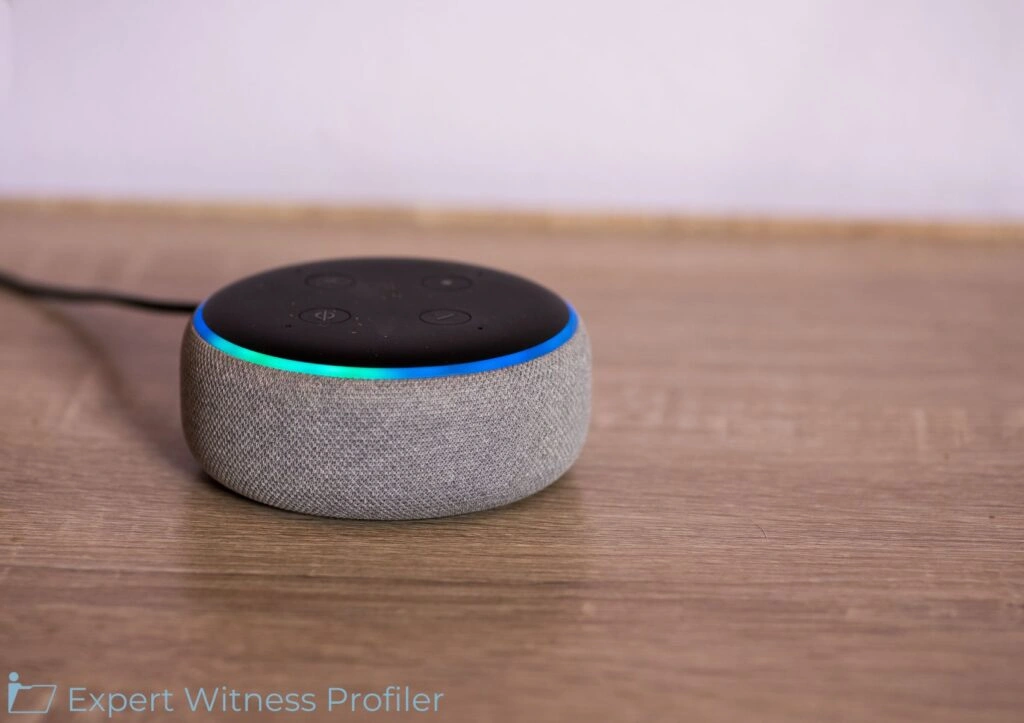
This class action lawsuit arises out of Amazon’s practice of using smart-speaker technology (“Alexa”) to surreptitiously: (a) intercept; (b) eavesdrop; (c) record; (d) disclose; or (e) use millions of Americans’ voices and communications, all without their knowledge or consent. Such conduct blatantly violates Washington’s wiretapping law, which applies nationwide to Plaintiffs and all members of the Class.
Defendants here, Amazon.com, Inc. and Amazon.com Services LLC (collectively, “Amazon” or “Defendants”), are therefore liable as a result of their egregious violations of the State Wiretapping laws – and are also liable for their violations of the Washington Consumer Protection Act (“CPA”), the Electronic Communications Privacy Act of 1986 (“Federal Wiretap Act”), and the Stored Communications Act of 1986 (“SCA”). Plaintiffs Kaeli Garner, Jodi Brust, Diane McNealy, Michael McNealy, Ricky Babani, Jeffrey Hoyt, Lorlie Tesoriero, Ronald Johnson, Selena Johnson and Caron Watkins (collectively, “Plaintiffs”) brought this action individually, and on behalf of a Class of similarly situated individuals, to redress those violations of law.
Amazon filed a motion to exclude the testimony of Plaintiffs' expert Jonathan Hochman. Defendants sought to exclude Hochman's testimony that (a) a large collection of utterances or speech data has value and can be utilized for various purposes, (b) each individual user's data has discrete value in and of itself, and (c) Amazon could have programmed Alexa to record only the voices of registered users.
Computer Science Expert Witness
Jonathan E. Hochman, PhD. has 35 years of experience in software product development, internet technology, online marketing, and cybersecurity. He is a Yale University graduate with four degrees in computer science. He currently teaches classes on computer privacy and is conducting research related to computer security, privacy, and distributed computing.
Between stints as a student, Hochman founded companies aimed at assisting clients with internet marketing and internet security, developing secure and private user authentication options, and integrating systems to maximize data capture and efficiency. He has also served as an expert regarding online data collection practices, software development, marketing, e-commerce, and internet security. His most recent article and research involve the tension between maintaining large data repositories for machine learning and safe-guarding individual privacy.
Discussion by the Court
A. Knowledge and Expertise
Amazon argued that Hochman's admitted expertise in amassing, handling, using, and analyzing data is not transferrable to this case because his experiences involved types of data other than voice data. The distinction is unexplained and is unclear in this context. The challenged testimony is being offered to show the ways in which large quantities of data are used to train and improve products (such as the Alexa device), to explain the means by which Amazon and other market participants value the data they use for such purposes, and to provide a basis for the jury to conclude that consumers have been injured by Amazon's collection of the data. Whether that data is in the form of a key stroke or an utterance is not dispositive of the relevant legal analysis.
Amazon also argued that Hochman lacks training and/or experience in economics and is therefore unable to assign a value to the data Amazon collects and uses. Hochman has not, however, offered an opinion regarding the actual value of the voice recordings at issue, either individually or en masse.
Finally, Amazon objected to the opinions set forth in Section D.i. of Mr. Hochman's report, namely that "it is technologically feasible for products to not record a voice that is not registered or recognized." This opinion is based on Hochman's interpretation of internal Amazon documents, his understanding of how Apple's Siri virtual assistant works, and his work experiences with internet user authentication and identification through voice prints. The fact that he has not developed or created a voice print authentication system does not prevent him from opining that such a thing exists.
B. Helpfulness
Amazon argued that (1) proof that voice data has value to Amazon is insufficient to prove that Alexa customers were injured by Amazon's taking of the data and (2) even if the collection and use of the data caused injury, Hochman has not proposed a damages model capable of measuring or calculating damages in the absence of individualized proof.
Amazon does not dispute that it has a need for and values the voice recording data it collects. Before Alexa was capable of collecting the necessary utterances — i.e., before the product was fully deployed and in homes across the country — Amazon paid people to generate and contribute their audio data. Once Alexa became operational, however, Amazon opted to take, store, and use the utterances recorded by the system rather than pay users for that privilege. A reasonable fact finder could conclude that Amazon's allegedly unfair acts deprived Alexa users of the opportunity to sell their voice data, thereby giving rise to an "injury to property" commensurate with the value of the taken data.
While the collected data undoubtedly has a higher value to Amazon than it does to individual Alexa users, Hochman's testimony is sufficient to allow the fact finder to conclude that, had Amazon not simply taken the voice recordings, a mutually agreeable price for the data could have been reached and the users were deprived of that value.
Moreover, Hochman offers at least two common methods for establishing the value of the voice data Amazon took and used for its own purposes without compensation, namely (a) the fair market value of individual utterances or monthly subscriptions for the data and (b) the costs Amazon is incurring or has incurred to acquire non-Alexa voice recordings.
C. Regurgitation of Documents
Amazon asserted that "most of Opinions 3 and 4" consisted of nothing more than quotations from Amazon's documents and/or that the quoted documents require no expertise to understand and apply in this case.
Amazon made no attempt to explain why Hochman should be precluded from relying on Amazon's documents to support his opinions that the utterances Amazon has collected, individually and as a collective, have value.
Held
The Court denied the Defendants' Daubert motion to exclude the testimony of Jonathan Hochman.
Key Takeaway
Hochman used his experience, education, and selected resources (including Amazon's documents) to define the terms of art used in this litigation, to explain how Alexa works and improves with both positive and negative training data, to show why the data Amazon has been collecting has value, and to identify various choices Amazon made in furtherance of its efforts to collect voice data regardless of user privacy interests.
Case Details:
| Case Caption: | Garner V. Amazon.Com, Inc. |
| Docket Number: | 2:21cv750 |
| Court Name: | United States District Court for the Western District of Washington |
| Order Date: | January 05, 2026 |